Objectif Métropoles "Tell me what you drink and I will tell you who you are"
Water, this universal yet unevenly distributed resource, is an essential common good, present everywhere and yet so often invisible.
Tell me what you drink and I will tell you who you are
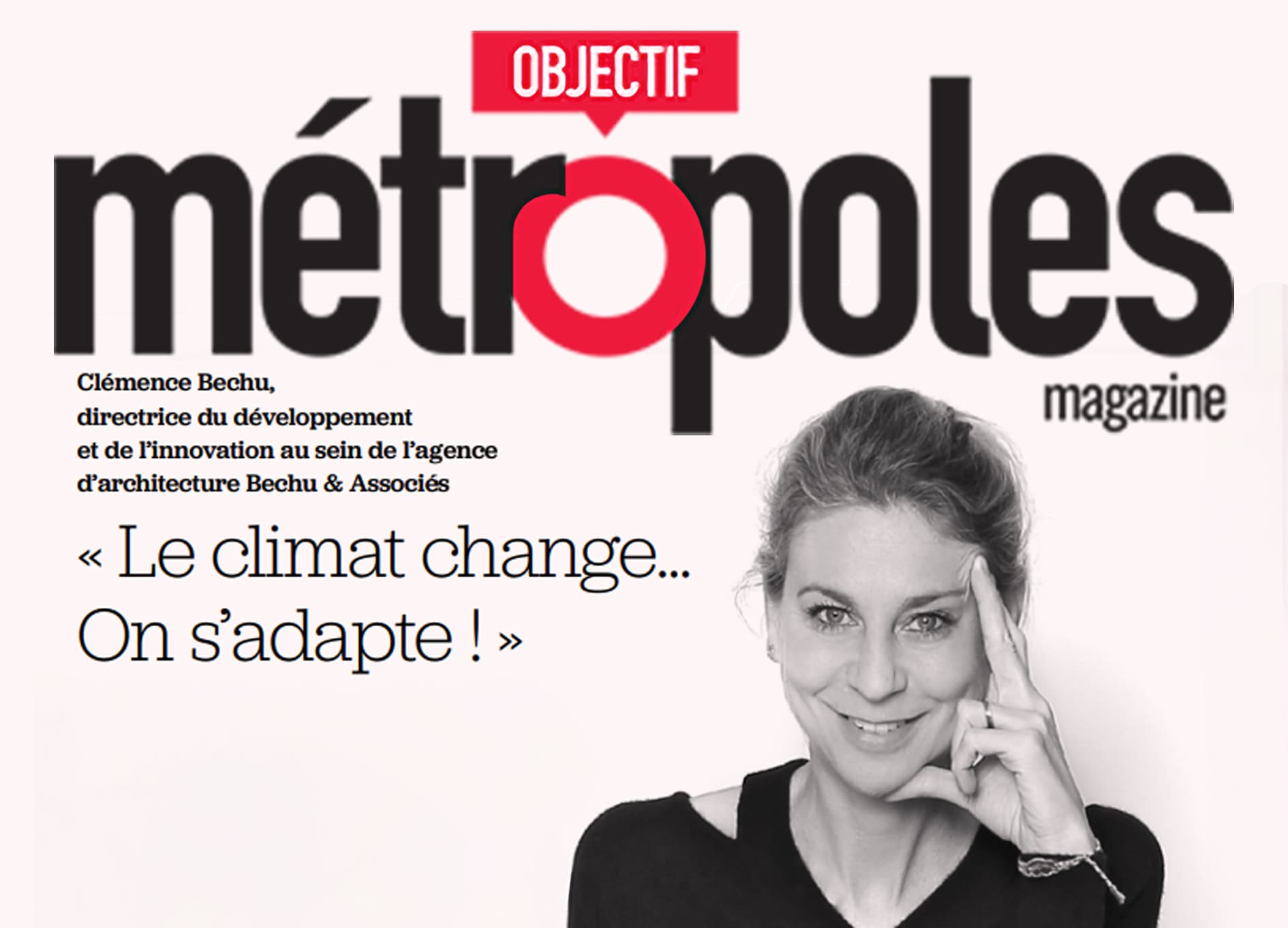
In her column, clemence bechu offers not only her perspective but also new ways of making the city in order to adapt to climate change. Here, the focus is on water as a resource at the heart of our ecosystems.
Water, this universal yet unevenly distributed resource, is an essential common good, present everywhere and yet so often invisible. It is part of our daily lives without us paying attention to it. Like a silent oxymoron of our modern lives. All over the world, it now crystallises three major global tensions: water that is lacking, increasingly often; water that overflows, increasingly violently; polluted water, which poisons silently. Despite its vital nature, and therefore its central role for any society, water remains largely absent from strategic thinking on climate change. It all too often slips past strategic priorities, even though it underpins all other balances: climate, biodiversity, health, agriculture, energy.

A French lag
In 100 years, global water consumption has increased sixfold, while the population has only quadrupled.
According to the UN, global demand will increase by another 50% by 2030. And by 2050, one in four people will live in a country affected by chronic shortages. Freshwater represents only 0.5% of the water available on Earth. Omnipresent, it is nonetheless often available in the wrong place, at the wrong time, and of poor quality. In 2024, only nine countries will concentrate 60% of global reserves. At the same time, conflicts of use are intensifying: between agriculture, tourism, industry, and urban needs, trade-offs are becoming painful. France is not spared: 20% of drinking water is lost through network leaks. And yet, less than 1% of wastewater is reused there. While Israel exceeds 85%, Germany reaches 25%, and Spain 9%, France lags behind. A striking paradox for a country that is nevertheless a pioneer in sustainable cities in many respects. But things are changing. With European Regulation (EU) 2020/741, which came into force in 2023, and clarified by Delegated Regulation (EU) 2024/1765, setting minimum requirements for wastewater recycling, France finally has a clear framework to accelerate. This is an opportunity for regions to set an example, to bring forth ambitious pilot projects, and to embed recycled water into local planning cycles. A revealing indicator of social as well as climatic inequalities, water sometimes becomes an obstacle to the development of our territories. In recent years, current events have repeatedly shown building permits being refused in areas lacking sufficient water resources. In 2023, in the Var region, the Pays de Fayence suspended urbanization for four years. A turning point: water has become a criterion for urban feasibility.
When uses reveal our paradoxes
We do not only drink water: we project onto it an imaginary of purity, health, and social status.
Tap water, filtered, bottled, micro-filtered, raw… Each choice reflects a cultural stance, a belief, or a value. A study by Culligan conducted in Paris showed this: water lies at the heart of a system of representations. People sometimes recycle water from the dryer, buy facial misters, or transport bottles over 300 kilometers just to place them on their table. And yet, it takes three liters of water and a quarter of a liter of oil to produce a single liter of bottled water in plastic. Meanwhile, one in three people in the world has no direct access to drinking water. In Kenya, in Nairobi’s slums, a cubic meter of water can cost 5 dollars, about a third of a monthly salary.
The city, the great forgotten of the water transition
The sustainable city has often made greening or soft mobility its priorities.
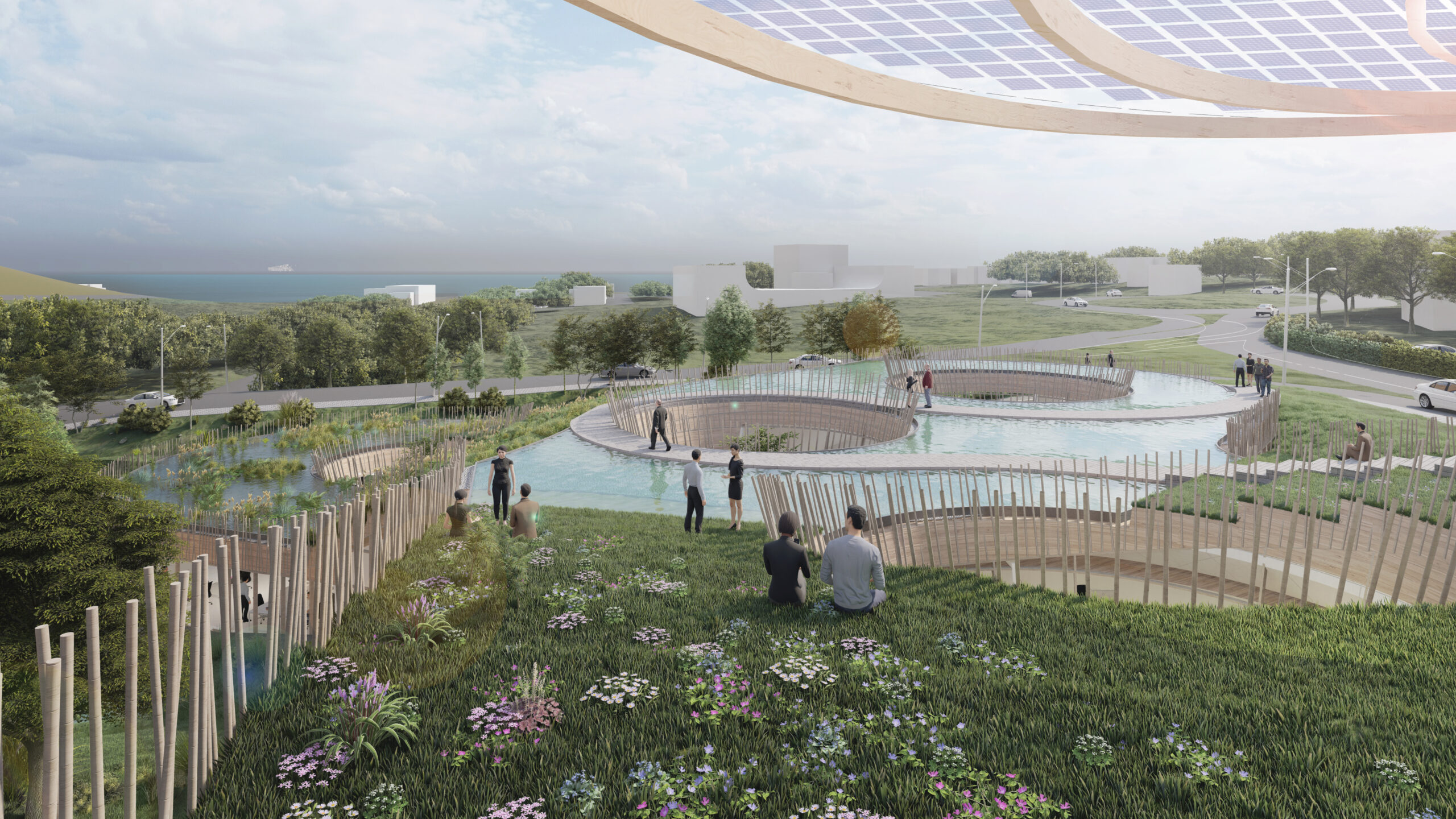
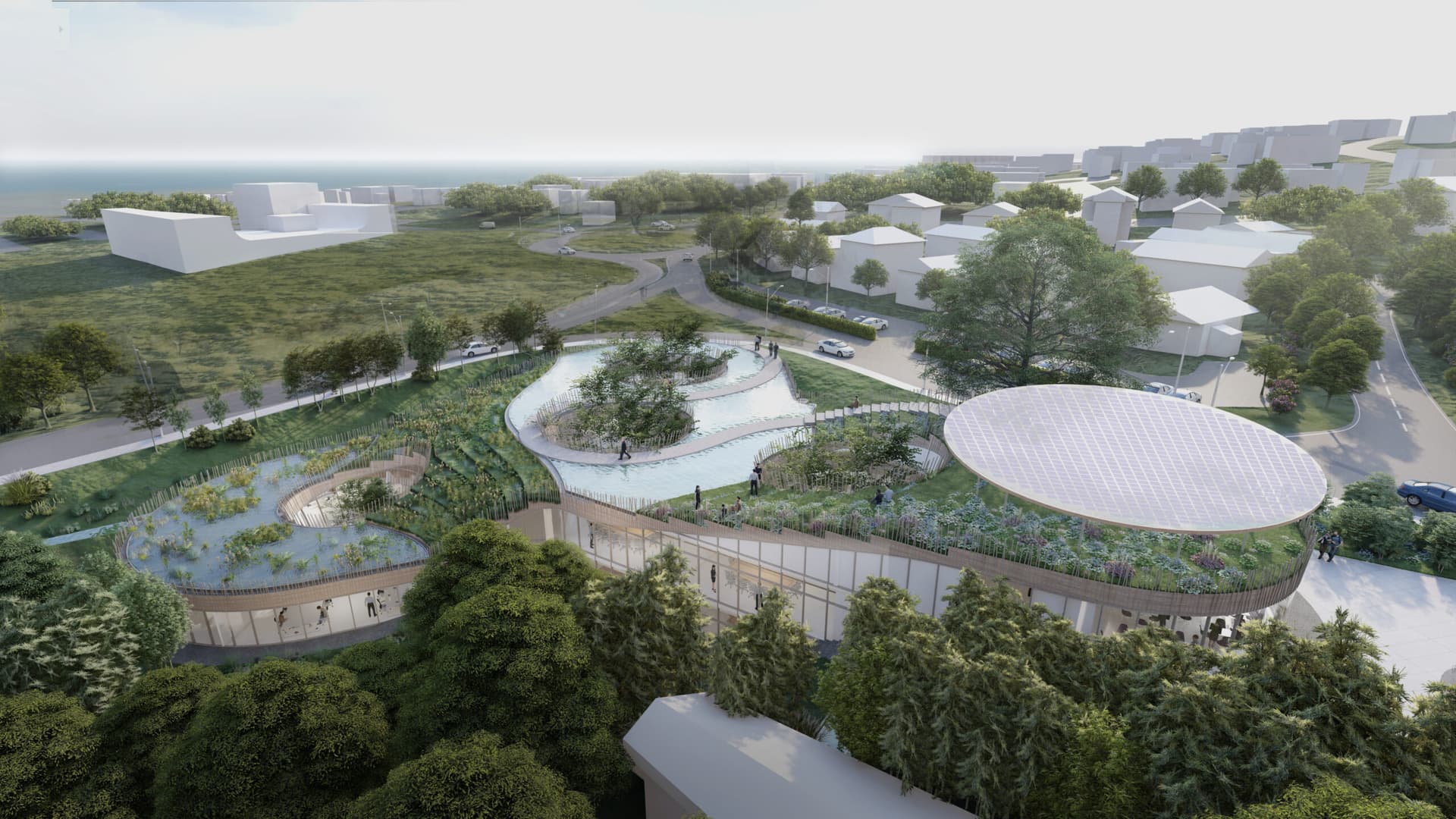
Yet water remains little considered as an infrastructure or as an active element of the project. In our professions as architects and urban planners, water has for too long been treated as a purely functional flow. It crosses buildings without inscribing itself in them, without inspiring them. However, this must change. Because water is becoming a limiting factor: without resources, no more permits. Without storage, no resilience. Without networks, no city. Good practices are not lacking, however. In Hendaye, a secondary school has equipped its facilities with dry toilets and new-generation urinals, saving 500,000 liters of water per year and ensuring its capacity to accommodate students even during increasingly frequent summer water cuts. In Mongolia, in Ulaanbaatar’s future Hunnu district, the Bechu & Associés agency has taken water management very far on site: greywater recovery, local infiltration, passive humidification. In an extreme climate and with no stable network, every drop counts. Elsewhere, ancient solutions are resurfacing: in the Atacama Desert in Chile, cloud nets have been capturing the camanchaca mist for centuries. An ancestral technique rediscovered to bring life back to deserts.
Towards a cultural governance of water
Rethinking our relationship with water means repoliticizing a resource long taken for granted.
It means putting an end to invisibility to enter a new era: that of ecological capacity. It also means thinking in terms of education. Raising awareness among the youngest about the water cycle, its uses, and its precious nature. A friend who grew up in Egypt recently told me how concern for water was part of her daily life. One never let water run without thinking. People constantly asked themselves: is it drinkable? Can we drink it? Can we use it? She quoted this phrase her parents used to repeat: “Careful, you’re going to drain all the Nile’s water!” As our territories are warming, it is useful to observe how these issues are addressed elsewhere, in places that have long lived with heat. Drinking then becomes a political act. And designing a building, a district, a city… now means composing with water: respecting it, retaining it, valuing it. Yet, even though access to water has been recognized since 2010 by the United Nations as a universal human right, there is still no international body dedicated exclusively to its governance. Water remains treated transversally in climate or biodiversity COPs, without being addressed as a subject in its own right. But what could be more vital, more transversal, more urgent? And what if we went further? At a time when Conferences of the Parties are organized for climate and biodiversity, why not imagine a COP dedicated to water? It deserves full and complete recognition. Because it is the invisible thread of all balances, and the vital element of every adaptation… but also the mirror of nations’ contradictions. So, in the absence of a climate barometer or a carbon indicator, could we not look at things differently? More simply? Because, ultimately, what we do with water also speaks of what we do with the world and what we are ready to become.